

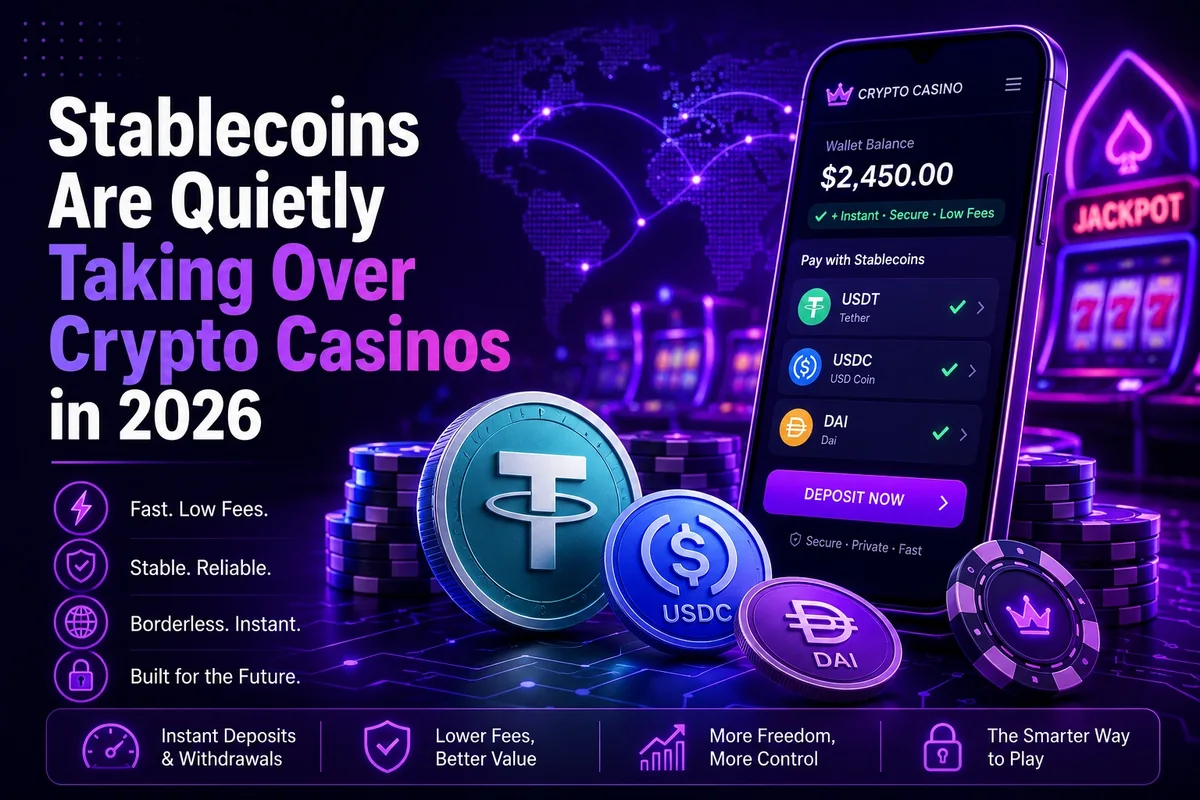
Spend a few months testing crypto casinos, as we do, and you notice something that doesn't make the headlines: hardly anyone deposits in Bitcoin any more. When we fund a fresh account in 2026, the cashier almost always defaults to Tether (USDT) or USD Coin (USDC), and the Bitcoin option has quietly slid down the list. That's not a fluke on one or two sites. It's the whole market moving at once.
The numbers back up the hunch. By spring 2026, stablecoins had crossed half of all crypto-denominated wagers on licensed and semi-licensed casinos, with USDT alone accounting for roughly 60% of the stablecoin slice. In the space of a couple of years, the coin that built crypto gambling, Bitcoin, has handed the tables over to tokens pegged to the dollar. That is a quiet revolution for a corner of the industry that once treated volatility as part of the thrill.
Why the switch happened
The reason is refreshingly practical, and any player who lived through a volatile week already understands it. Bitcoin's price swings created a structural problem for gambling: a $100 deposit on Monday could be worth $80 by Friday, or $150, purely on market movement, before you'd even placed a bet. That turns every session into two gambles stacked on top of each other, one at the table and one on the exchange rate. Win at blackjack and still lose money because the coin dropped overnight, and the casino starts to feel rigged even when it isn't.
Stablecoins remove the second gamble. A $100 USDT deposit is still worth $100 when you cash out, regardless of what the crypto market did overnight. For anyone who just wants to play slots or sit at a live blackjack table without also day-trading their bankroll, that stability is the entire appeal. You keep the speed and privacy of crypto and drop the volatility that never belonged in a casino balance in the first place.
| Factor | Bitcoin deposit | Stablecoin (USDT/USDC) |
|---|---|---|
| Value stability | Swings with the market | Pegged 1:1 to the US dollar |
| Deposit speed | Minutes (network dependent) | Seconds to minutes on layer-2 |
| Network fees | Can spike when chains are busy | Low on Tron, Polygon and other L2s |
| Best for | Holders happy to ride price moves | Players who want a balance that stays put |
The plumbing got better, too
Stability alone didn't do all the work. The rails underneath crypto casinos matured at the same time. Layer-2 settlement made small transfers cheap and near-instant, so a stablecoin withdrawal no longer means watching a confirmation counter and praying gas fees behave. Provably fair game engines, where you can verify the outcome of a hand or a spin on-chain, went from niche selling point to something players actively look for. And loyalty schemes increasingly hang off on-chain tokens rather than a dusty points balance you forget about.
Live dealer has ridden the same wave. Real-croupier blackjack, roulette, baccarat and the game-show formats now account for roughly a third of crypto casino revenue, up from well under a fifth a few years ago. Stable balances make those longer live sessions far more comfortable. Nobody wants their stake quietly re-pricing between hands of blackjack.
USDT, USDC and the network you send them on
Not all stablecoins are identical, and the differences matter more than most cashiers let on. USDT (Tether) is the older, more widely accepted token, so it turns up on almost every crypto casino and usually has the deepest liquidity. USDC (USD Coin) is issued by Circle and tends to lead on transparency, publishing regular attestations of the reserves behind it. For most players the practical question is simply which one your casino supports and which one your wallet already holds.
The network you send on matters just as much as the coin. The same USDT can travel over several blockchains, and the chain you pick decides your fee and your waiting time. Send it over an old, congested network and you can pay a painful fee on a small cash-out. Send the same amount over a low-cost chain and the fee barely registers. Always match the network your casino lists, because sending a token on the wrong chain is one of the few crypto mistakes that can lose your money for good.
| USDT (Tether) | USDC (USD Coin) | |
|---|---|---|
| Issuer | Tether | Circle |
| Casino coverage | Accepted almost everywhere | Widely accepted, a touch less universal |
| Known for | Liquidity and reach | Reserve transparency |
| Peg | 1:1 to the US dollar | 1:1 to the US dollar |
| Best when | Your site lists only one stablecoin | You want regular reserve attestations |
Regulation caught up
For years, regulators pretended crypto wagering wasn't really happening. That era is over. In Europe, the Markets in Crypto-Assets (MiCA) framework has reshaped the landscape: operators are expected to register with national regulators, run proper AML and KYC checks, and, crucially for stablecoins, hold reserves that are audited by certified third parties. In plain terms, the token in your casino balance is more likely than ever to be backed by an actual dollar sitting somewhere.
That's a genuine win for players, even if it dents the wild-west romance of early crypto casinos. "Anonymous and unaccountable" is fun until a withdrawal disappears. We'd rather send you to a site that answers to someone.
How we factor this into reviews
When we test a crypto casino, we deposit in a stablecoin, play through it and time the payout with a stopwatch, the same deposit-to-withdrawal audit we run everywhere. A site that supports USDT or USDC, settles quickly and holds a verifiable licence scores better than one leaning on Bitcoin volatility and a vague Curaçao badge. You can see the results in our market crypto guides.
What it means for you
If you play with crypto, the practical takeaway is simple: default to a stablecoin unless you have a specific reason to hold Bitcoin. You'll get a balance that means what it says, faster and cheaper withdrawals on modern chains, and, at a properly licensed site, reserves that someone actually checks. If you're comparing operators by market, our tested shortlists are the place to start: crypto casinos in the UK, crypto casinos in Australia, casino crypto in France and crypto casino Nederland.
None of this changes the golden rule. A stable balance is easier to manage, but it's still money you should be prepared to lose. Set a limit before you deposit, and treat the entertainment as the product, not the profit.
FAQ
Are stablecoins really always worth a dollar?
They are designed to be, and the big ones hold that peg almost all of the time by keeping reserves that back each token. Brief wobbles have happened during past market panics, but for the length of a normal casino session a USDT or USDC balance behaves like dollars. That stability is the whole reason players switched to them.
Should I deposit in USDT or USDC?
Use whichever your casino supports and your wallet already holds. USDT is accepted almost everywhere and has the deepest liquidity; USDC is known for publishing regular reserve attestations. Both track the dollar one to one, so for a player the real difference is availability, not value.
Why does the deposit screen ask which network to use?
The same stablecoin can travel over several blockchains, and each one has its own fees and speed. Pick the network your casino lists and send on that exact chain. Sending a token over the wrong network is one of the few crypto errors that can lose your funds permanently.
Are stablecoin casinos legal where I live?
It depends entirely on your local rules, which change often. The safest route is a casino that holds a recognised licence and runs the identity and anti-money-laundering checks that frameworks like MiCA now expect. Our market guides only list sites we can actually verify.
Is a stablecoin withdrawal faster than a bank transfer?
Usually, yes. Once a casino approves your cash-out, a stablecoin payment on a modern chain often lands in minutes rather than the one to three business days a card or bank transfer can take. The slow part is almost always the casino's own review, not the blockchain.
Do I still need to complete identity checks?
At a properly licensed site, yes. The no-questions era is fading. Expect standard know-your-customer checks, especially on your first withdrawal. That is a good sign, not a red flag: a site that verifies players is far more likely to still be around when you want to cash out.
Play responsibly
Gambling should be fun, never a way to make money or chase losses. If it stops feeling like entertainment, use the deposit limits, cooling-off tools and self-exclusion every licensed casino provides, or read our responsible gambling guide. 18+ only.